
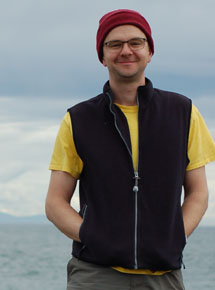
John Kessler
- Professor
- Department Chair, Earth and Environmental Sciences
PhD, University of California Irvine, 2005
210 Hutchison Hall
(585) 273-4572
john.kessler@rochester.edu
Office Hours: By appointment
Research Overview
Dr. Kessler and his lab investigate chemical oceanography with an emphasis on isotope biogeochemistry to elucidate methane and carbon dioxide dynamics within the oceanic system as well as across other Earth systems. He is driven to conduct this research by a desire to quantify feedbacks associated with global climate change. The oceanic methane and carbon dioxide systems are not only the largest global reservoirs of these greenhouse gases in active exchange with the atmosphere, but some of the largest global carbon reservoirs. In addition, the oceanic methane system is a dynamic, metastable, and relatively unexplored reservoir that has the potential for large and explosive feedbacks with climate due to the potency of methane as a greenhouse gas. The research in this lab quantifies the dynamics at the junction of these two greenhouse gas systems. Unique analytical chemistry and isotope (radio and stable) biogeochemistry measurement techniques are developed in this lab, and the data these techniques produce are used in regional geochemical models to quantify methane and carbon dioxide biogeochemical dynamics. Past projects have been conducted in the Atlantic and Pacific Oceans, Gulf of Mexico, Alaskan Arctic and Subarctic, Cariaco Basin, Black Sea, and US Great Lakes focusing on such natural features as, for example, methane clathrate hydrates, subsea permafrost, and hydrocarbon seeps, as well as the biochemical processes in the water column that may enhance or limit its atmospheric release. Overall, the long term goal of this laboratory is to study the dynamics at the junction of the oceanic methane and carbon dioxide systems especially with respect to climate change.
Research Interests
- Chemical Oceanography
- Isotope geochemistry
- Analytical chemistry
Courses Offered (subject to change)
- EES 212 / 412: A Climate Change Perspective to Chemical Oceanography, Syllabus
- EES 261 / 461: Stable Isotope Geochemistry: Fractionation Equations and Models, Syllabus
- EES 307 / 407: Advanced Seminar in Climate and Environmental Change, Syllabus
- EES 312W: Research in Ocean Biogeochemistry, Syllabus
Selected Publications
Bold indicates graduate student authors.
- Louden, S. L. & Kessler, J. D. (2023). The emission of low pH water from Gulf of Mexico seeps as revealed by δ13C-CO2 and methane oxidation data. Environmental Science: Advances, 2, 1600-1606. https://doi.org/10.1039/D3VA00117B
- Joung, D.-J., Ruppel, C. D., Southon, J., Weber, T. S., & Kessler, J. D. (2022). Negligible atmospheric release of methane from decomposing hydrates in mid-latitude oceans. Nature: Geoscience, 15, 885-891. https://doi.org/10.1038/s41561-022-01044-8
- Garcia‐Tigreros, F., Leonte, M., Ruppel, C. D., Ruiz‐Angulo, A., Joung, D. J., Young, B.*, & Kessler, J. D. (2021). Estimating the impact of seep methane oxidation on ocean pH and dissolved inorganic radiocarbon along the U.S. Mid‐Atlantic Bight. Journal of Geophysical Research: Biogeosciences, 126, e2019JG005621. https://doi.org/10.1029/2019JG005621
- Chan, E.W., A.M. Shiller, D.J. Joung, E.C. Arrington, D.L. Valentine, M.C. Redmond, J.A. Breier, S.A. Socolofsky, and J.D. Kessler (2019). Investigations of Aerobic Methane Oxidation in Two Marine Seep Environments: Part 1-Chemical Kinetics. Journal of Geophysical Research: Oceans, 124, 8852-8868. https://doi.org/10.1029/2019JC015594
- Sparrow, K. J., J. D. Kessler, J. R. Southon, F. Garcia-Tigreros, K. M. Schreiner, C. D. Ruppel, J. B. Miller, S. J. Lehman, and X. Xu (2018). Limited contribution of ancient methane to surface waters of the U.S. Beaufort Sea shelf. Science Advances, 4(1), eaao4842. https://doi.org/10.1126/sciadv.aao4842
- Leonte, M., J. D. Kessler, M. Y. Kellermann, E. C. Arrington, D. L. Valentine, and S. P. Sylva (2017). Rapid rates of aerobic methane oxidation at the feather edge of gas hydrate stability in the waters of Hudson Canyon, US Atlantic Margin. Geochimica et Cosmochimica Acta, 204, 375-387. https://doi.org/10.1016/j.gca.2017.01.009
- Ruppel, C. D. and J. D. Kessler (2017). The Interaction of Climate Change and Methane Hydrates. Reviews of Geophysics, 55(1), 126-168. https://doi.org/10.1002/2016RG000534
- Paytan, A., A. Lecher, N. Dimova, K. Sparrow, F. Garcia-Tigreros Kodovska, and J.D. Kessler (2015). Methane transport from the active layer to lakes in the Arctic using Toolik Lake, Alaska, as a case study. Proceedings of the National Academy of Sciences, 112(12), 3636-3640. https://doi.org/10.1073/pnas.1417392112
- Kessler, J.D. (2014). Atlantic Bubble Bath. Nature: Geoscience, 7(9), 625-626. https://doi.org/10.1038/ngeo2238
- Du, M., and J.D. Kessler (2012). Assessment of the Spatial and Temporal Variability of Bulk Hydrocarbon Respiration Following the Deepwater Horizon Oil Spill. Environmental Science & Technology, 46(19), 10499-10507. https://doi.org/10.1021/es301363k
- Kessler, J.D., D.L. Valentine, M.C. Redmond, M. Du, E.W. Chan, S.D. Mendes, E.W. Quiroz, C.J. Villanueva, S.S. Shusta, L.M. Werra, S.A. Yvon-Lewis, and T.C. Weber (2011). A Persistent Oxygen Anomaly Reveals the Fate of Spilled Methane in the Deep Gulf of Mexico. Science, 331(6015), 312-315. https://doi.org/10.1126/science.1199697
- Valentine, D.L., J.D. Kessler, M.C. Redmond, S.D. Mendes, M.B. Heintz, C. Farwell, L. Hu, F.S. Kinnaman, S.A. Yvon-Lewis, M. Du, E.W. Chan, F. Garcia-Tigreros, and C.J. Villanueva (2010). Propane respiration jump-starts microbial response to a deep oil spill. Science, 330(6001), 208-211. https://doi.org/10.1126/science.1196830
- Onstott, T.C., D. McGown, J. Kessler, B. Sherwood Lollar, K.K. Lehmann, and S.M. Clifford (2006). Martian CH4: Sources, Flux, and Detection. Astrobiology, 6(2), 377-395. https://doi.org/10.1089/ast.2006.6.377
Research and Student Opportunities
Research in my laboratory focuses on oceanic methane isotope biogeochemistry investigations. Our projects are heavily rooted in analytical chemistry, while also being very multidisciplinary drawing from the fields of chemistry, geology, biology, physics, mathematics, and engineering. I am always interesting in talking with intelligent, enthusiastic, and hardworking students about the possibility of joining our team. I encourage prospective Master’s of Science and Ph.D. students to contact me directly before submitting an application to our graduate program. I also strongly encourage interested undergraduates to contact me about conducting independent research in my laboratory.